Scout Carry Leather Sheath Conversions
Horizontal carry, explained by someone who's actually built it — not just written about it.
Scout carry is one of the most practical ways to wear a fixed-blade knife, and one of the most misunderstood. Done right, the knife rides horizontally along the beltline, low-profile and out of the way until you reach for it. Done poorly, the sheath sags, rotates, or works the belt loop loose until the rig fails. Here's what I've learned building them.
| Fits Model | Built to fit one specific person's own working knife — not a single production model |
|---|---|
| Material | Vegetable-tanned leather, wet-molded to the individual blade; finished either plain (natural russet) or basket-weave stamped |
| Carry Style | Horizontal scout carry (belt-parallel) |
| Price Bracket | Not sold — made for family and friends. A commercial version would require the knife in hand to fit correctly, and would likely cost more than most buyers would pay for it |
| Attachment Method | Integrated wraparound belt loop — the front panel's leather wraps around to the back panel and forms the loop itself, rather than a separate loop sewn on |
The scout carry rigs I've built
I made these for family and friends — cowboys who run cattle on large ranches, not customers. Every one was built to that one person's own working knife, so no two are identical. Some are left plain in natural russet leather; others are basket-weave stamped with a tooled border. A few carry the owner's initials, tooled right into the wraparound flap.
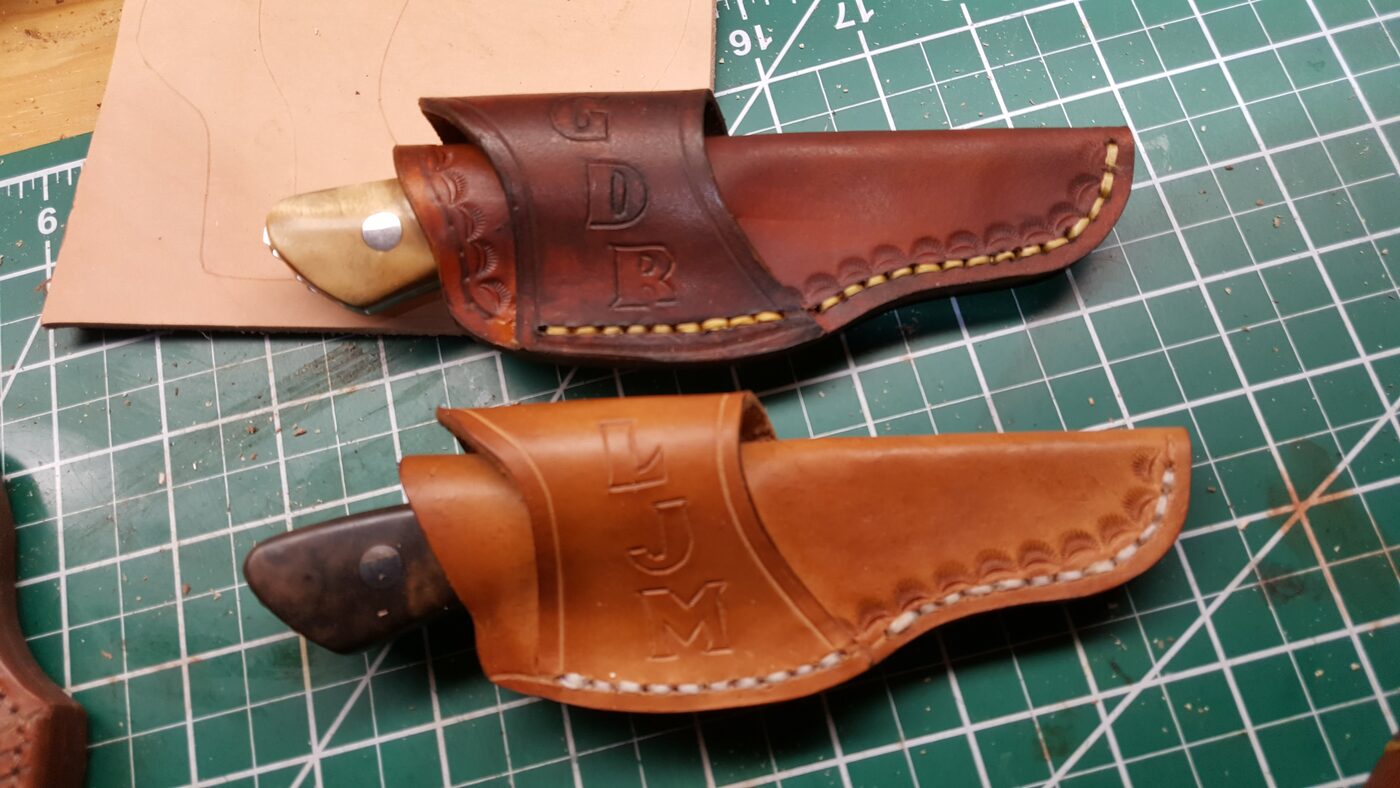
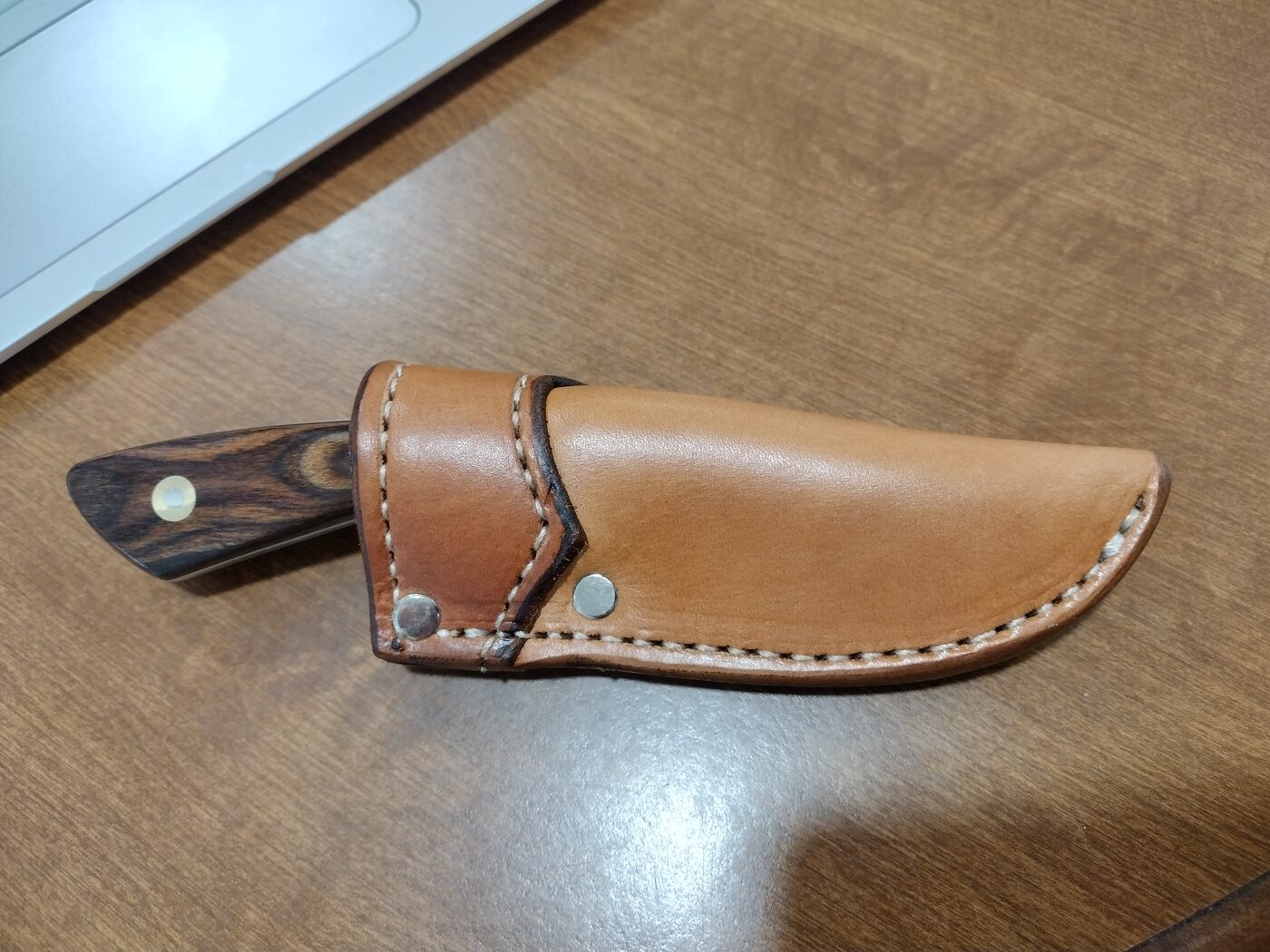
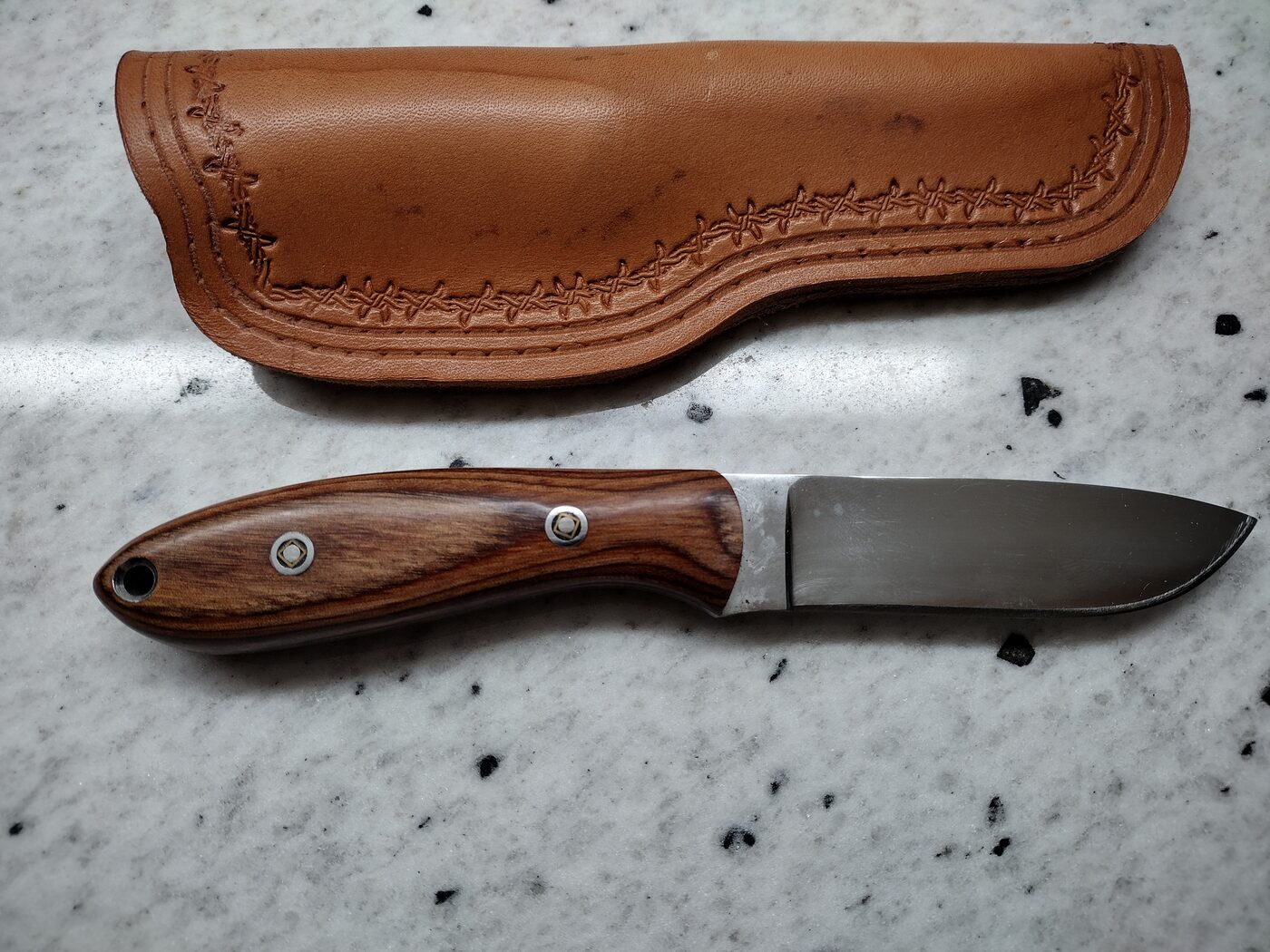
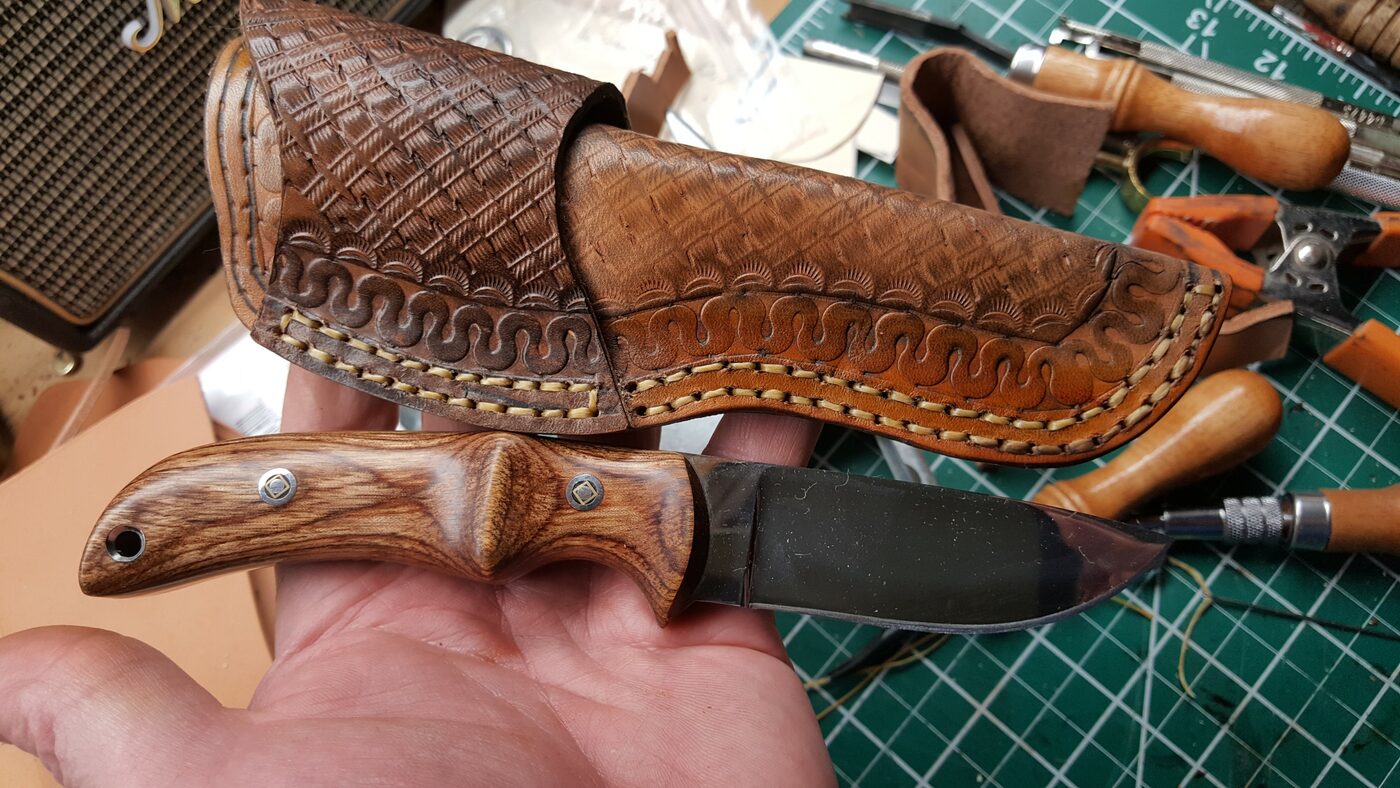
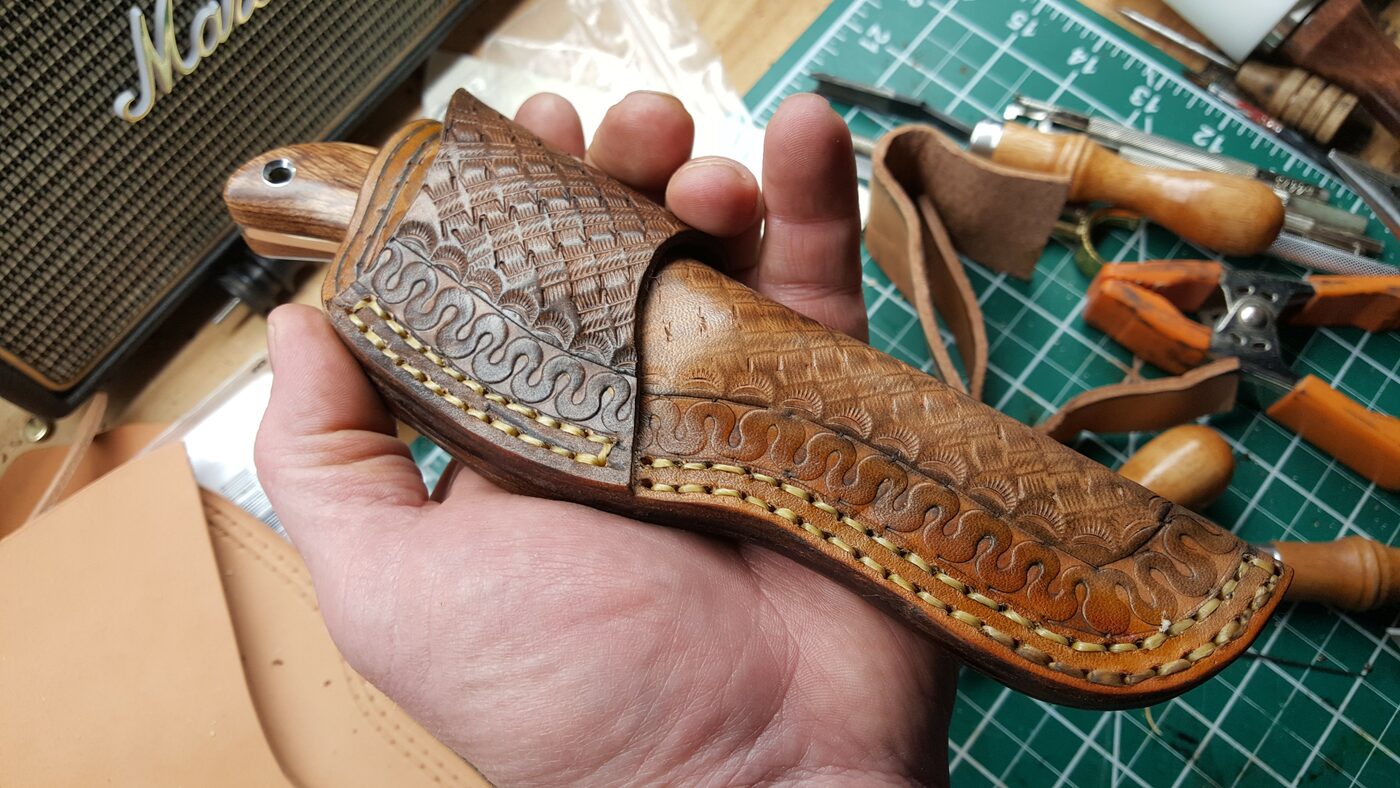
- Knife(s)
- Custom-fit to each person's own working knife, not a production model — handles ran from horn and bone to bocote and other hardwoods.
- Leather
- Vegetable-tanned, wet-molded to the individual blade. Some builds finished plain in natural russet; others basket-weave stamped with a tooled border along the stitch line.
- Belt loop
- Not a separate piece. The front panel's leather wraps around to the back panel and forms the loop itself — structural and decorative at once, since the tooling runs right across it.
- Retention
- A rivet set at the throat of the sheath, placed precisely enough to create friction against the blade so it can't slide out or fall free. Getting that tension right — not too loose, not so tight the blade won't seat — is the hard part of this build.
- Built for
- Family and friends — cowboys running cattle on large ranches, day in and day out. These were gifts, not sales, but built to the same standard as everything else on this bench. Several carry the owner's initials tooled into the leather.
What is a scout carry conversion?
A scout carry conversion is a sheath built to ride horizontally along the beltline, with the belt passing through two loops on the back rather than one loop hanging the sheath vertically.
The blade sits parallel to your beltline, handle angled toward your dominant hand. Compared to a vertical hip sheath, the horizontal orientation keeps the knife tucked closer to the body, spreads the weight across a wider span of belt, and clears the hip when you're seated, driving, or wearing a pack. The trade-off is a different draw, and a hard requirement for real retention, since a blade held sideways is fighting gravity the entire time you wear it.
Is leather or Kydex better for scout carry?
For scout carry specifically, quality vegetable-tanned leather is usually the better choice, because it wet-molds tight for silent retention and breaks in against the body instead of pressing hard points into your back.
Kydex is lighter and fully waterproof, and it has its place. But leather takes wet-molding, which is what makes a true custom horizontal conversion possible, and a well-treated piece will outlast several synthetic sheaths. The catch is that leather rewards good construction and punishes bad: thin hide, chrome-tanned stock, glued-only loops, and skipped edge finishing are the failure points to watch for — on your own builds or anyone else's.
What holds a scout carry sheath together at the belt loop?
On my builds, there's no separate belt loop at all — the front panel's leather wraps around to the back and forms the loop itself, stitched through as part of the body.
A horizontal sheath puts more strain on the loop than a vertical one, because the whole weight of the knife pulls sideways against it all day instead of hanging straight down. Making the loop and the body one continuous piece of leather, rather than a strip sewn on separately, is what keeps that joint from being the weak point. It also means the tooling can run straight across the loop without a seam interrupting it — function and looks solved by the same decision.
How do you keep the knife from falling out of a scout carry sheath?
A rivet set at the throat of the sheath, placed precisely enough to create friction against the blade, rather than relying on a snap, strap, or the mold alone.
This is the part of a scout carry build that's actually hard, and it's not the part most people expect. The rivet has to sit close enough to the blade to bind against it, but not so tight that the knife won't seat fully or draws hard enough to be annoying. Too loose and the sheath is useless for a working knife — it'll drop the blade the first time you bend over. I built these for cowboys running cattle on large ranches, all day, every day. That's not a sheath that gets to be almost right.
Can you buy a scout carry sheath like this?
Not from me — these were built for family and friends, not sold. But the reason is worth understanding if you're shopping for one from anyone.
A rivet-tensioned fit like this can't be built from a model number or a set of measurements. I'd need the actual knife in my hand to get the tension right, which means every one of these is a one-off, start to finish. That's exactly the kind of work that's expensive to do properly — more than most buyers would want to pay for a knife sheath, once you price in the hours instead of just the leather. The pricing and batching page goes into why that math rarely works out for custom pieces, and why a maker who sells this kind of build in volume is almost certainly doing something different than one-at-a-time custom fitting.
Can I convert a sheath to scout carry myself?
Yes — you can wet-mold your own scout conversion at home with vegetable-tanned leather, and done carefully it can hold up as well as a shop-built one.
The process is straightforward but unforgiving of shortcuts. Here's the honest walkthrough.
- Start with the right leather. Vegetable-tanned only — chrome-tanned won't hold a molded shape.
- Cut and dry-fit. Lay out the pattern with the knife in hand, mark your fold and loop positions, and confirm the blade seats fully before any water touches the leather.
- Set the belt loops first. Two horizontal loops sized to your belt width, riveted and stitched through the body. This is the joint that carries the load.
- Wet the leather. Submerge briefly until air bubbles stop, then let it return to a damp, pliable state — not soaking wet. Over-wetting weakens the finished piece.
- Mold to the blade. Protect the edge, wrap the knife, then press the damp leather firmly around the spine and handle transition with a bone folder until the shape is crisp.
- Let it dry fully. Air-dry at room temperature — never with direct heat, which cracks and shrinks the leather.
- Finish and treat. Burnish the edges, then condition with a leather oil to weatherproof it.
How does scout carry compare to a vertical hip sheath?
Scout carry rides lower-profile and clears the hip when seated; a vertical hip sheath gives a faster, more familiar straight-up draw.
Which is right depends on the blade and how you move. For heavier working blades, the construction demands are closer to what's on the Prather War Bowie build — thicker welts, more layers, and a point where thread alone stops being enough. The Lesche digger and pinpointer rigs show the same tradeoff at the heavy end, where rivets and screws take over from stitching.
Is a scout carry sheath a beginner leatherworking project?
No — the wet-molding and the retention tension are both easy to get wrong, and a scout carry sheath punishes both mistakes more than a simple vertical sheath does.
If you're new to leatherwork, start with something simpler and build up to this. The Prather War Bowie build and pricing and batching notes both go into the tools and the bench time a project like this actually takes.
Keep Reading
Lesche Digger & Pinpointer Sheaths
Four carry configurations built and sold — side-by-side, inline, separates, and thigh rig — with construction specs for each.
Randall-Style Sheath for the TOPS Prather War Bowie
A quarter-inch tang, three welts, five layers of veg-tan — and the stitching decision that made the build possible.
What to Charge for Custom Leather Work
Real numbers from a shop that ran a six-month backlog — what customization actually costs, and why batch production is the better business.